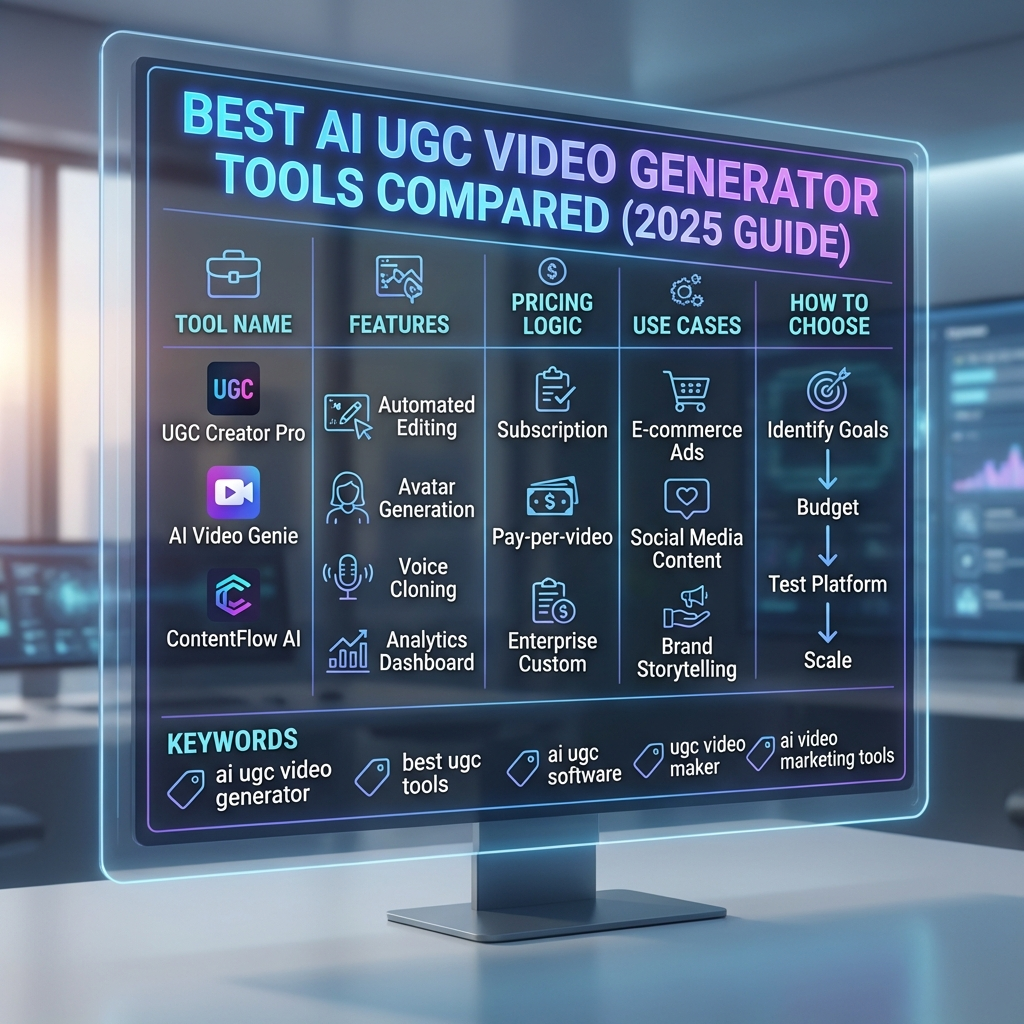
Best AI UGC Video Generator Tools Compared (2025 Guide)
UGC works—but producing it at scale is hard.
By 2025, most brands no longer ask whether they should use UGC. They ask a more practical question:
Which AI UGC video generator actually helps us test, iterate, and scale?
The market is crowded with AI video tools, but only a subset are truly built for UGC-style, performance-driven short-form video.
This guide compares the best AI UGC video generator tools in 2025, explains what really matters when choosing one, and helps you avoid tools that look impressive but fail in real marketing workflows.
What Is an AI UGC Video Generator (Really)?
An AI UGC video generator is not just a “video maker.”
A true AI UGC tool must be able to:
· create creator-style videos (not brand ads)
· support short-form formats (TikTok / Reels / Shorts)
· generate multiple variations fast
· keep content native and human-sounding
· integrate into performance testing workflows
If a tool can’t do those things, it’s not a UGC tool—it’s just a video editor with AI features.
What Actually Matters When Comparing AI UGC Tools
Before listing tools, let’s clarify evaluation criteria. This is where most comparison articles fail.
1. UGC Authenticity (Most Important)
Ask:
· Does the output feel like a real creator?
· Or does it feel like a slideshow / corporate explainer?
UGC success depends on tone, pacing, and structure—not visual polish.
2. Speed & Iteration
Winning brands test many creatives, not one.
A good AI UGC tool should:
· generate multiple hooks easily
· create variations without starting over
· support fast revisions
If iteration is slow, performance suffers.
3. Short-Form Optimization
UGC lives in:
· TikTok
· Instagram Reels
· YouTube Shorts
Tools must be optimized for:
· 9:16 vertical
· captions-first viewing
· fast pacing
Long-form video tools usually fail here.
4. Workflow Fit (Not Features)
The best tool is the one that fits your workflow:
· ads testing
· product pages
· content calendars
More features ≠ better results.
Categories of AI UGC Video Generator Tools
Instead of ranking randomly, it’s more useful to group tools by what they’re actually good at.
Category 1: UGC-Focused AI Video Generators (Best for Performance)
These tools are built specifically for:
· UGC-style structure
· short-form ads
· creator-like pacing
Strengths
· native-looking output
· fast hook testing
· ad-ready formats
Weaknesses
· less cinematic control (by design)
Best for
· e-commerce
· paid ads
· conversion-focused teams
If your goal is ROAS and scale, this category matters most.
Category 2: General AI Video Generators (Mixed Results)
These tools focus on:
· presentations
· explainers
· generic marketing videos
They often include:
· templates
· avatars
· stock footage
Strengths
· flexible use cases
· wide feature sets
Weaknesses
· content feels “designed”
· weak UGC authenticity
· slower iteration
Best for
· internal videos
· brand explainers
· non-performance use cases
They can produce UGC-like videos, but require heavy manual effort.
Category 3: AI Editors & Assistants (Support Tools)
These tools don’t generate full videos but help with:
· editing
· captions
· pacing
· repurposing
Strengths
· improve existing content
· speed up post-production
Weaknesses
· can’t generate UGC from scratch
Best for
· teams with creator footage
· content repurposing
These tools complement UGC generators—but don’t replace them.
Feature Comparison: What to Look For
|
Feature |
Why It Matters for UGC |
|
Script-based generation |
Enables testing messaging |
|
Multiple variations |
Reduces ad fatigue |
|
Short-form templates |
Matches platform behavior |
|
Human-style captions |
Improves retention |
|
Fast exports |
Keeps testing cycles short |
|
Brand voice control |
Maintains consistency |
If a tool lacks these, it will struggle in real campaigns.
Common Pitfalls When Choosing an AI UGC Tool
Mistake 1: Choosing Based on Demos Alone
Demos are curated. Real workflows are messy.
Always ask:
· How fast can I make 10 variations?
· How much manual cleanup is needed?
Mistake 2: Prioritizing Visual Effects
UGC doesn’t need:
· fancy transitions
· cinematic filters
It needs:
· clarity
· relatability
· proof
Over-designed tools often hurt performance.
Mistake 3: Ignoring Workflow Cost
A “cheap” tool that takes 3× longer to use is expensive.
Speed is a cost variable.
Which AI UGC Tool Is Best for You?
Choose a UGC-Focused Tool If:
· you run paid ads
· you test creatives weekly
· conversion rate matters
· speed matters
Choose a General AI Video Tool If:
· you need explainers
· branding is the priority
· UGC is not your core channel
Combine Tools If:
· you generate UGC + repurpose content
· you mix ads and organic
The best stacks are simple, not bloated.
How Top Brands Use AI UGC Tools in Practice
Winning teams follow this loop:
1. Write multiple hooks
2. Generate UGC-style videos
3. Launch ads
4. Analyze performance
5. Kill losers
6. Scale winners
7. Refresh weekly
AI tools enable the loop—but structure makes it work.
The Future of AI UGC Video Tools
In 2025 and beyond, the best tools will:
· feel less “AI-generated”
· focus more on pacing and structure
· integrate analytics feedback
· optimize for conversion signals
The winning tools won’t advertise “AI.”
They’ll advertise results.
Final Verdict: Don’t Ask “Which Tool Is Best?”
Ask:
Which tool helps us test and learn faster?
UGC success comes from:
· volume
· iteration
· clarity
AI UGC video generator tools are not creative magic.
They are force multipliers.
Choose the one that:
· fits your workflow
· preserves authenticity
· accelerates learning
Everything else is noise.
Conclusion
The best AI UGC video generator in 2025 is not the one with the most features—it’s the one that helps you produce believable, testable, scalable UGC content faster than your competitors.
If your videos look good but don’t convert, the tool doesn’t matter.
If your tool helps you learn faster, it’s the right one.
UGC is a system.
AI is the engine.
Speed is the advantage.