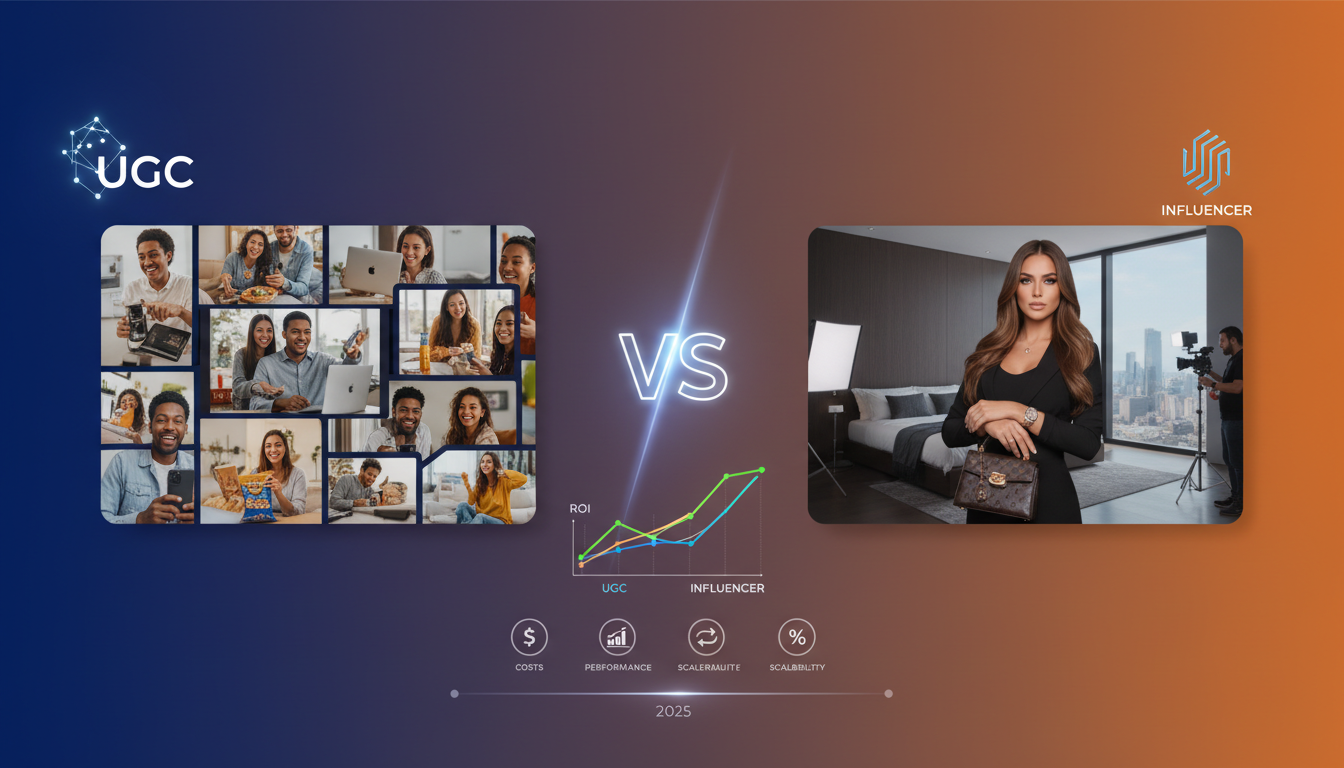
UGC vs Influencer Marketing: Which Works Better in 2025?
For years, influencer marketing dominated social media budgets. Brands paid for reach, visibility, and credibility borrowed from popular creators.
But in 2025, a fundamental shift has happened.
Brands are no longer asking, “Who has the biggest audience?”
They’re asking, “What content actually converts?”
That question has brought UGC (User-Generated Content) marketing to the center of performance strategy—and forced brands to reconsider the role of influencers entirely.
This article breaks down UGC vs influencer marketing, compares their strengths and weaknesses, and explains which approach works better depending on your goals, budget, and growth stage.
What Is UGC Marketing?
UGC marketing focuses on creator-style content, not creator reach.
UGC videos are:
· native-looking
· product-focused
· designed for brand-owned distribution
Brands use UGC content across:
· paid ads
· product pages
· landing pages
· organic social feeds
The creator’s follower count is irrelevant. What matters is whether the content:
· feels authentic
· communicates value clearly
· drives action
UGC is content-first marketing.
What Is Influencer Marketing?
Influencer marketing is audience-first.
Brands partner with creators who already have:
· followers
· engagement
· social credibility
Influencers post sponsored content to their own channels, exposing the brand to their audience.
Influencer marketing excels at:
· awareness
· social proof
· brand association
But reach does not guarantee conversion—and that distinction matters more than ever.
UGC vs Influencer Marketing: Core Differences
|
Category |
UGC Marketing |
Influencer Marketing |
|
Primary asset |
Content |
Audience |
|
Distribution |
Brand-owned channels |
Influencer channels |
|
Cost basis |
Per asset |
Per post / follower count |
|
Scalability |
High |
Limited |
|
Creative control |
High |
Shared |
|
Speed |
Fast |
Slow |
|
Best for |
Performance & testing |
Awareness & reach |
This difference explains why many brands now treat UGC as infrastructure—and influencers as optional amplification.
Performance: Which Converts Better?
UGC Performance Strengths
UGC consistently outperforms influencer ads in:
· click-through rates
· cost per acquisition
· creative fatigue resistance
Why?
· Feels native to feeds
· Focuses on one clear benefit
· Uses relatable language
· Shows proof quickly
UGC behaves like a recommendation, not an endorsement.
Influencer Performance Strengths
Influencers still perform well when:
· the creator-brand fit is strong
· the audience trusts the creator
· the goal is awareness, not immediate conversion
However, influencer content often underperforms when reused as ads because:
· it’s optimized for engagement, not clarity
· messaging is diluted to fit personal branding
Cost Comparison: Where Budgets Go Further
Influencer Marketing Costs
Brands often pay for:
· follower count
· exclusivity
· usage rights
Costs scale upward quickly, while output remains limited.
UGC Marketing Costs
UGC costs are tied to:
· content volume
· formats
· variations
Brands can often produce 10–30 UGC videos for the cost of one influencer post—making UGC far more cost-efficient for testing and scaling.
Scalability: The Deciding Factor in 2025
Modern performance marketing requires:
· frequent creative refresh
· constant testing
· rapid iteration
UGC excels here because:
· formats are reusable
· variations are easy to generate
· production can be systemized
Influencer marketing struggles to scale because:
· creators are unavailable or slow
· content quality varies
· revisions are limited
In fast-moving ad platforms, speed wins.
Creative Control & Brand Consistency
With UGC:
· brands define messaging
· hooks are tested
· CTAs are optimized
With influencers:
· creators protect their voice
· brands compromise on structure
· messaging consistency suffers
This doesn’t make influencers “bad”—but it makes them harder to integrate into performance systems.
Trust: Authenticity vs Familiarity
Influencers create trust through familiarity.
UGC creates trust through relatability.
In 2025, relatability often converts better than fame.
Viewers trust content that:
· sounds like them
· solves a real problem
· avoids hype
UGC wins here because it mimics peer-to-peer communication.
When Influencer Marketing Still Makes Sense
Influencer marketing still works well for:
· brand launches
· top-of-funnel awareness
· social proof campaigns
· community building
Especially when:
· creators align deeply with brand values
· partnerships are long-term
· content isn’t reused as ads
Influencers are powerful—but not scalable by default.
When UGC Is the Better Choice
UGC is usually better when you need:
· ad creatives that convert
· fast testing cycles
· lower acquisition costs
· consistent messaging
This is why many brands:
· test with UGC first
· scale winning messages
· then amplify with influencers if needed
UGC informs influencer strategy—not the other way around.
The Hybrid Model (What Smart Brands Do)
The most effective brands in 2025 use both, strategically.
They:
1. Use UGC to test messaging and formats
2. Identify what converts
3. Brief influencers using proven frameworks
4. Repurpose content across channels
UGC becomes the testing engine.
Influencers become the amplifier.
Common Myths About UGC vs Influencers
“UGC can’t build brands.”
UGC builds trust—the foundation of brand equity.
“Influencers are more authentic.”
Authenticity comes from relevance, not follower count.
“UGC replaces influencers.”
UGC replaces inefficiency, not people.
2025 Verdict: Which Works Better?
There is no universal winner—but there is a clear trend.
· For performance, testing, and scale → UGC wins
· For reach, awareness, and community → influencers still matter
The brands that win in 2025 are not choosing sides.
They are choosing systems over assumptions.
Conclusion
UGC and influencer marketing are not enemies—they serve different roles.
But if your goal is:
· faster growth
· lower costs
· higher conversion rates
UGC is no longer optional.
Influencers can amplify success.
UGC creates it.