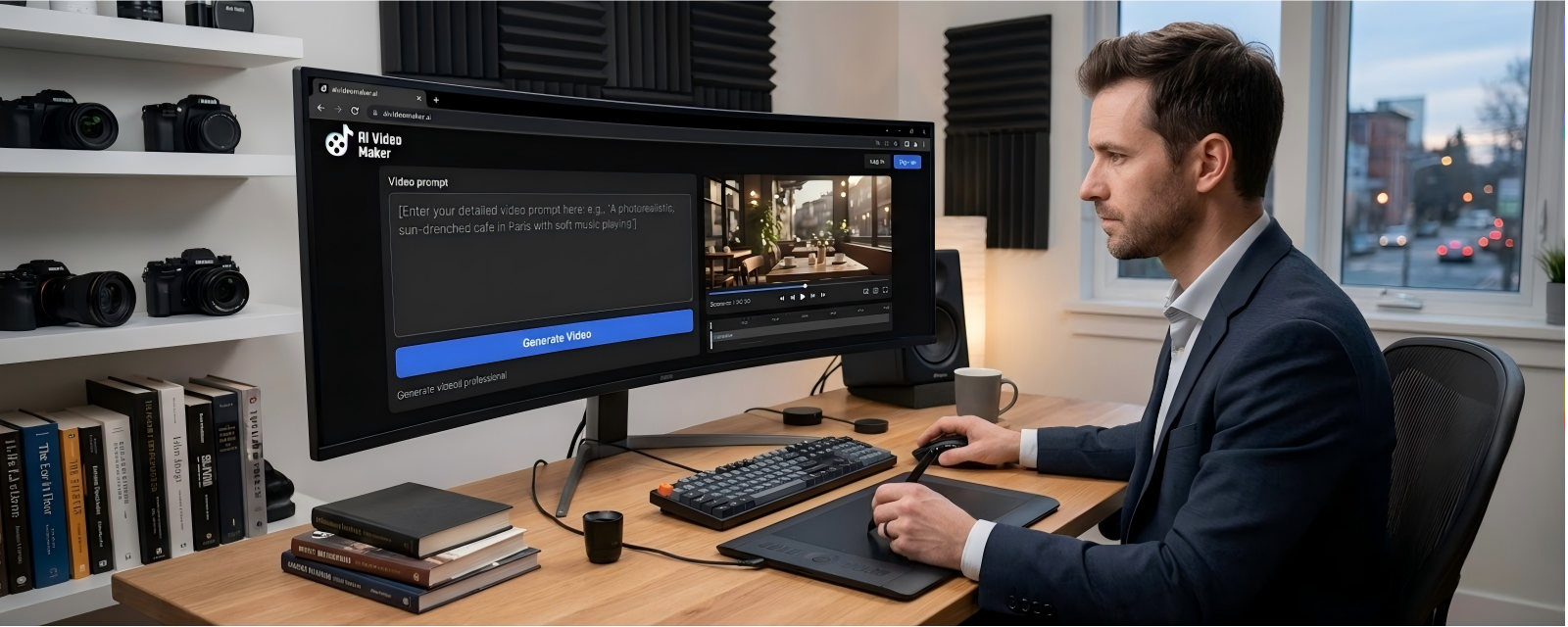
The Ultimate Guide to Using a Text to Video AI Generator for Content Creation

The Ultimate Guide to Using a Text to Video AI Generator for Content Creation
Introduction
The modern digital content ecosystem is relentlessly demanding, forcing creators, enterprise marketing divisions, and independent publishers to continuously output high-fidelity visual assets at an unsustainable computational velocity. Traditional video production pipelines are fundamentally crippled by severe operational pain points: astronomical live-action production costs, catastrophic supply chain delays when coordinating studio shoots, and the crippling software learning curves associated with legacy non-linear editing (NLE) platforms. To mathematically eradicate these immense electromechanical and financial liabilities, deploying an advanced text to video AI generator is no longer a speculative technological luxury; it is an absolute engineering mandate for maintaining commercial relevance.
Historically, transforming a raw conceptual script into a broadcast-ready video sequence required days of manual keyframing, rendering, and compositing. Today, sophisticated machine learning architectures have completely bypassed this manual bottleneck. By translating natural language inputs directly into highly complex, temporally consistent pixel arrays, these algorithmic engines democratize cinematic production. Users can generate fluid, hyper-realistic motion sequences without requiring thousands of dollars in GPU hardware or decades of animation experience.
This comprehensive B2B technical guide will aggressively deconstruct the core physics of neural rendering, evaluate the strict parameter configurations required for optimal prompt engineering, and detail exactly how transitioning your workflow to a free AI video maker guarantees unprecedented speed-to-market and infinite creative scalability for your entire content catalog.
Core Neural Rendering & Motion Advantages
To objectively comprehend the mechanical superiority of an advanced online video generator, computing engineers must deeply analyze the underlying mechanics of latent diffusion models and Natural Language Processing (NLP) integration. When a user inputs a text prompt, the NLP transformer model mathematically tokenizes the semantic data, breaking down complex visual requests into high-dimensional vectors. These vectors are then projected into a latent space, mapping the contextual relationships between subjects, lighting variables, and camera physics.
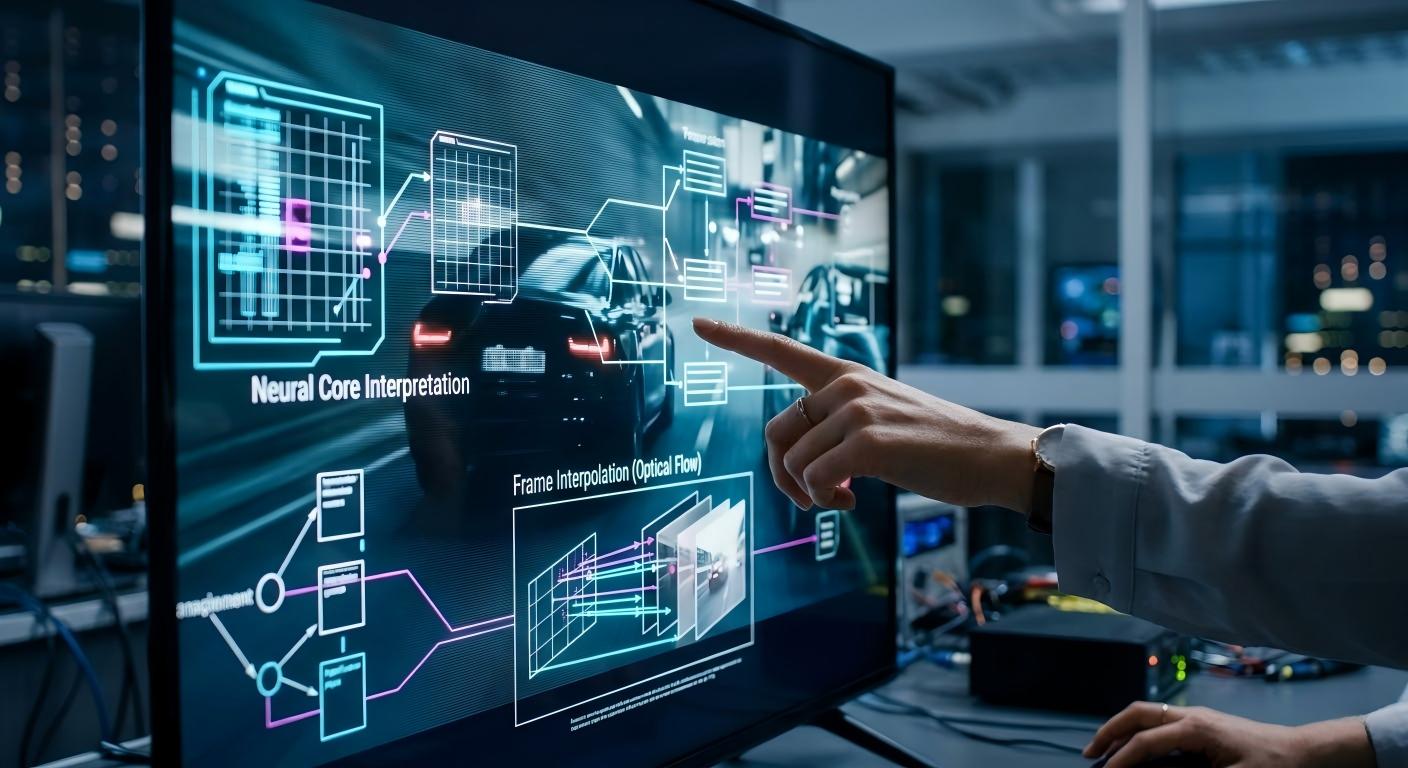
The core rendering engine, such as the highly optimized Wan 2.2 model, operates on the principles of reverse diffusion. The system initiates with a field of pure mathematical Gaussian noise. Through iterative denoising steps guided by the text vectors, the AI hallucinates distinct pixels, effectively synthesizing high-fidelity imagery out of pure static. However, generating a single static image is entirely insufficient for video production. The true technological breakthrough lies in temporal consistency and frame interpolation physics.
In traditional procedural animation, software struggles to maintain the physical geometry of an object as it rotates through three-dimensional space. An advanced AI video generator utilizes attention mechanisms across the temporal axis to mathematically lock the structural topology of characters and environments from frame 1 to frame 120. Furthermore, the engine executes highly advanced frame interpolation, predicting and rendering the precise sub-pixel motion vectors required between keyframes to ensure flawlessly smooth, 24fps or 30fps cinematic playback without the jarring, hallucinatory flickering that plagued early-generation models.
Critical Market Applications & Real-World Use Cases
The strategic deployment of prompt-driven neural rendering is aggressively dictated by the hyper-accelerated product lifecycles of the modern digital advertising space. In the era of algorithmic commerce, digital marketers and social media agencies cannot afford the traditional four-week production pipeline utilized by legacy broadcast television. Consequently, when a specific micro-trend surges on platforms like TikTok or YouTube Shorts, these digital-first entities must initiate A/B testing instantaneously to capture peak consumer engagement.
Therefore, performance marketers actively deploy an AI content creation pipeline to systematically generate hundreds of highly targeted video hooks per day. Furthermore, by feeding varying text prompts into the generator, they can mathematically test different visual environments, lighting scenarios, and camera movements against a single narrative script. Consequently, this unparalleled capability for rapid iteration allows the agency to instantly identify the highest-converting visual asset, maximizing Return on Ad Spend (ROAS) while completely bypassing the logistical nightmare of scheduling live-action reshoots.
Furthermore, independent YouTube creators and documentary channels utilize this technology to synthesize highly complex b-roll footage that would otherwise be financially impossible to acquire. Therefore, instead of purchasing expensive licensing rights for drone footage of a historical event or a microscopic view of cellular biology, the creator simply commands the AI to render the exact sequence. Consequently, this strategic utilization of a convert text to video framework drastically reduces pre-production overhead, allowing lean creator teams to compete directly with massive media conglomerates in terms of visual production value and output frequency.
Comparison Table: Video Production Architectures
To objectively evaluate the structural and financial viability of varying video production methodologies, procurement engineers must critically analyze the deployment data. The following 4-column table mathematically contrasts Text to Video AI Generation against legacy industry alternatives across critical performance metrics.
| Production Methodology | Speed to Publish & Scalability | Cost & Resource Overhead | Creative Control & Visual Coherence |
|---|---|---|---|
| Text to Video AI Generation | Supreme. Renders complete, complex sequences in minutes. Infinite scalability. | Near-Zero. Requires only a minimal monthly SaaS subscription; no hardware required. | High. Controlled entirely through precise prompt engineering and seed locking. |
| Traditional NLE Editing | Slow. Requires days of manual timeline splicing, color grading, and rendering. | High. Demands expensive GPU hardware, software licenses, and skilled human labor. | Absolute. Pixel-perfect manual control, but heavily restricted by available footage. |
| Stock Footage Splicing | Moderate. Time is wasted hunting for matching clips across expensive databases. | High. Premium stock subscriptions or pay-per-clip licensing destroys profit margins. | Poor. Highly inconsistent lighting and actors between different stock clips. |
| Outsourced Animation Studio | Extremely Slow. Storyboarding, rigging, and rendering take weeks to months. | Astronomical. Requires thousands of dollars in labor fees for a single minute of video. | High, but requires agonizingly slow communication loops and expensive revision rounds. |
Prompt Engineering Best Practices & Technical Specs
Executing a flawless sequence generation requires absolute adherence to the syntactic structure of algorithmic parsing. The most critical operational parameter in utilizing a text-to-video model is mastery over AI prompt engineering. Unlike conversational chatbots, rendering engines do not interpret vague sentiment; they require highly explicit, mathematically structured descriptive vectors. To guarantee high-fidelity outputs, users must systematically construct prompts that explicitly define the subject, the environmental lighting, the camera physics, and the atmospheric rendering style.
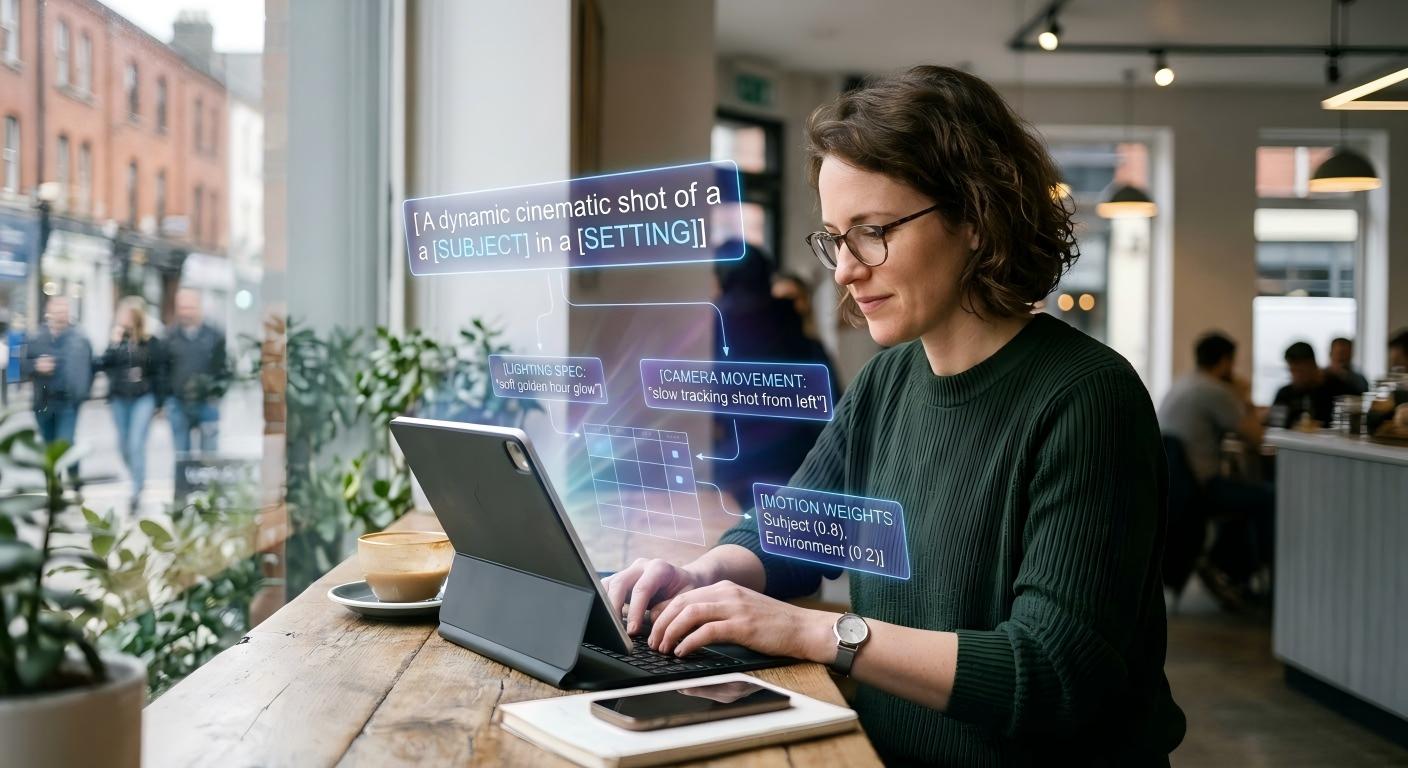
For example, simply inputting 'a car driving' will yield a highly volatile, generic result. A properly engineered prompt must read: 'A sleek, black sports car driving aggressively down a neon-lit cyberpunk city street at midnight, heavy rain reflecting volumetric lighting, tracking shot from a low angle, cinematic depth of field, 8k resolution, photorealistic.' By explicitly defining 'volumetric lighting' and 'tracking shot from a low angle,' the user mathematically forces the neural network to simulate precise digital cinematography, ensuring the lighting remains coherent as the focal subject moves through the Z-axis of the latent space.
Furthermore, managing motion physics requires strict syntactic commands. Many users struggle with models over-hallucinating movement, resulting in chaotic, morphing subjects. To prevent this, engineers utilize specific motion weight descriptors. Adding terms like 'slow motion,' 'subtle camera pan,' or 'static subject, dynamic background' mathematically throttles the frame-interpolation aggressiveness. This ensures the spatial topology of the primary subject remains rigidly locked while permitting fluid, realistic physics in the surrounding environment.
Frequently Asked Questions (FAQ)
1. What is the fundamental difference between the free 480p tier and HD exports?
The mathematical resolution of the output file. 480p (Standard Definition) is optimized for rapid drafting, consuming zero computational credits, and is ideal for testing prompt viability. To achieve commercial-grade clarity required by modern high-density displays, users must upgrade to export in 720p or utilize the AI Video Upscaler to interpolate the file into mathematically sharp 1080p HD.
2. How does the Wan 2.2 model architecture prevent temporal flickering?
Early generation models rendered each frame independently, causing severe localized topological shifts (flickering). The Wan 2.2 architecture utilizes advanced cross-frame temporal attention layers. It mathematically 'remembers' the physical geometry of frame 1 and strictly enforces that geometry across frame 60, preventing the subject from spontaneously mutating during playback.
3. Can I run multiple generation prompts simultaneously?
On the standard free tier, jobs are strictly processed sequentially to prevent server overload. By upgrading to a Premium or Pro subscription tier, the system allocates dedicated GPU instances to your account, unlocking concurrent job queuing. This allows digital marketers to mathematically process dozens of A/B test variations simultaneously.
4. How do I maintain exact character consistency across multiple generated clips?
Currently, true zero-shot character consistency purely from text is mathematically highly complex. The most effective engineering workflow is to generate a highly accurate base image using the AI Image Generator, lock the reference seed, and transition to an Image-to-Video workflow, utilizing the 'AI Consistent Character' tools to maintain facial topology across varying scenes.
5. What aspect ratios are natively supported by the text-to-video generator?
The neural network is trained to natively output resolutions mathematically optimized for modern digital distribution. Users can specify output aspect ratios within the platform's UI, including 16:9 (standard landscape for YouTube/Web) and 9:16 (vertical portrait mode perfectly calibrated for TikTok, Reels, and YouTube Shorts) without requiring secondary cropping in an NLE.
6. Do I retain commercial rights to the videos I generate?
Under the free tier, generations are strictly licensed for personal use and contain a cryptographic watermark. By upgrading to any paid subscription tier, the watermark is entirely removed, and the user is granted absolute, unconditional commercial rights to monetize, broadcast, and distribute the generated video files across all global advertising platforms.
Conclusion
The engineering reality within the digital content landscape is irrefutable: attempting to scale a modern marketing division or creator channel using archaic, manual video production pipelines guarantees catastrophic operational bottlenecks and extreme financial bleed. By migrating your creative workflow to a precision-engineered AI video maker, you permanently mathematicalize your production speed, visual fidelity, and market readiness. You guarantee absolute resistance to production delays, eradicate the need for expensive hardware rendering farms, and unlock the infinite creative scalability required to dominate your specific digital sector.
Do not compromise your brand's operational survival with slow, expensive live-action shoots. Whether you are engineering complex narrative shorts or require a high-throughput manufacturing partner to execute a massive global advertising rollout, explore the immense capabilities of our Zero-Anxiety generation infrastructure. To bypass hidden paywalls and begin drafting immediately, visit AI Video Maker. Secure your commercial dominance by upgrading your creative supply chain today. Access the Text to Video AI Tool to execute your first prompt, and fundamentally revolutionize your digital trajectory.