Enhance Your Content: Why You Need an AI Video Upscaler

Enhance Your Content: Why You Need an AI Video Upscaler
Introduction
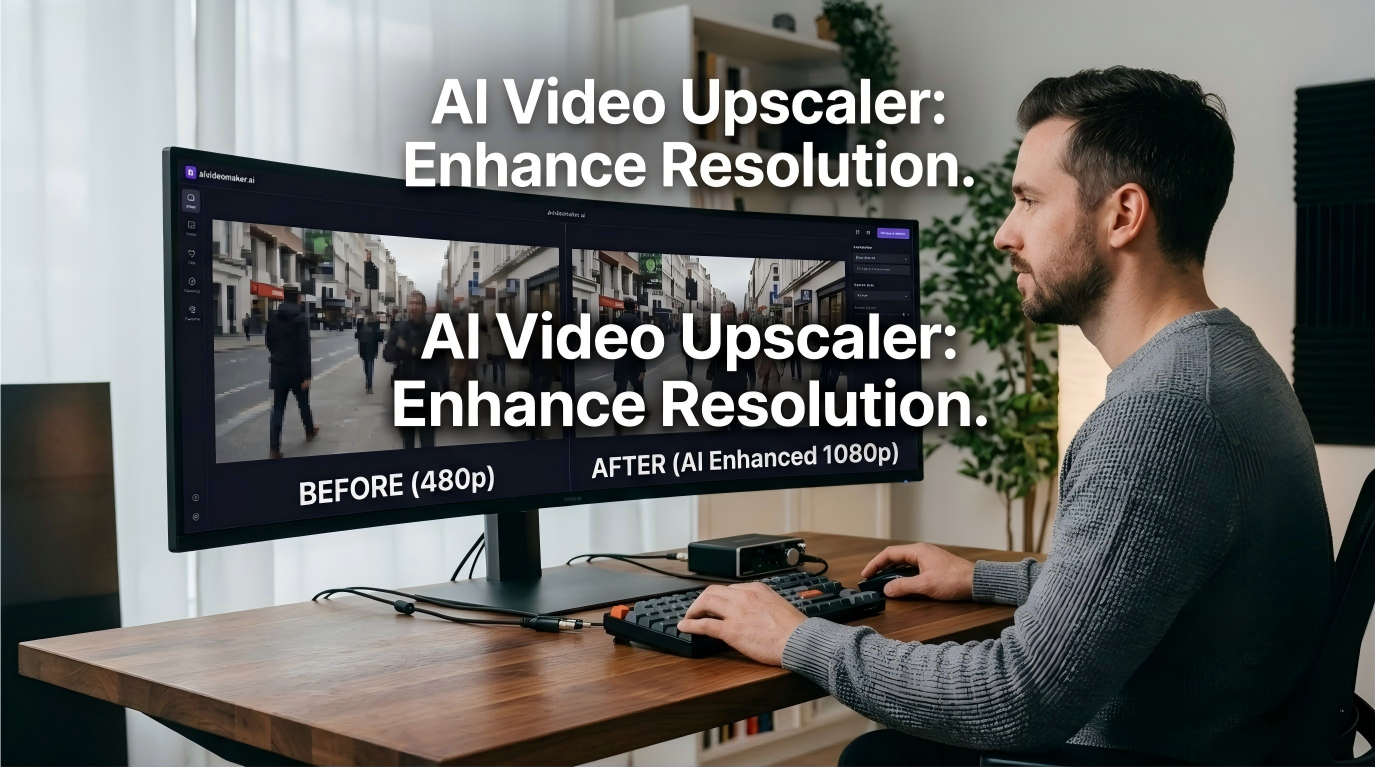
In the highly demanding ecosystem of digital post-production and commercial broadcasting, editors are continuously paralyzed by severe resolution constraints. The operational pain points are catastrophic: heavily pixelated exports, violently compressed social media uploads, and fundamentally unusable low-resolution drafts that instantly destroy a brand's visual authority. To mathematically eradicate these immense structural liabilities and rescue compromised footage, deploying an advanced AI video upscaler is no longer a speculative luxury; it is an absolute engineering mandate for any competitive media division.
Historically, attempting to enlarge a 480p source file to HD specifications using legacy non-linear editing (NLE) platforms resulted in disastrous visual degradation. Traditional interpolation algorithms merely stretched the existing pixels, exponentially multiplying the inherent compression artifacts and rendering the footage soft, blurry, and entirely unprofessional for commercial distribution. High-definition broadcast standards require strict pixel density, and legacy software structurally failed to synthesize the missing topological data required to meet these rigorous parameters.
Today, complex neural network architectures have completely bypassed this mechanical bottleneck. By migrating from rudimentary bilinear stretching to deterministic pixel hallucination, digital operators can mathematically synthesize lost detail, transforming degraded media into pristine, broadcast-ready assets. This comprehensive B2B technical guide aggressively deconstructs the algorithmic physics of super-resolution and spatial-temporal artifact reduction. We will critically evaluate the strict parameter configurations required for optimal noise suppression, and detail exactly how transitioning your post-production pipeline to a video resolution enhancer guarantees unprecedented fidelity, flawless detail recovery, and infinite creative scalability across your entire visual catalog.
Core Super-Resolution & Artifact Reduction Advantages
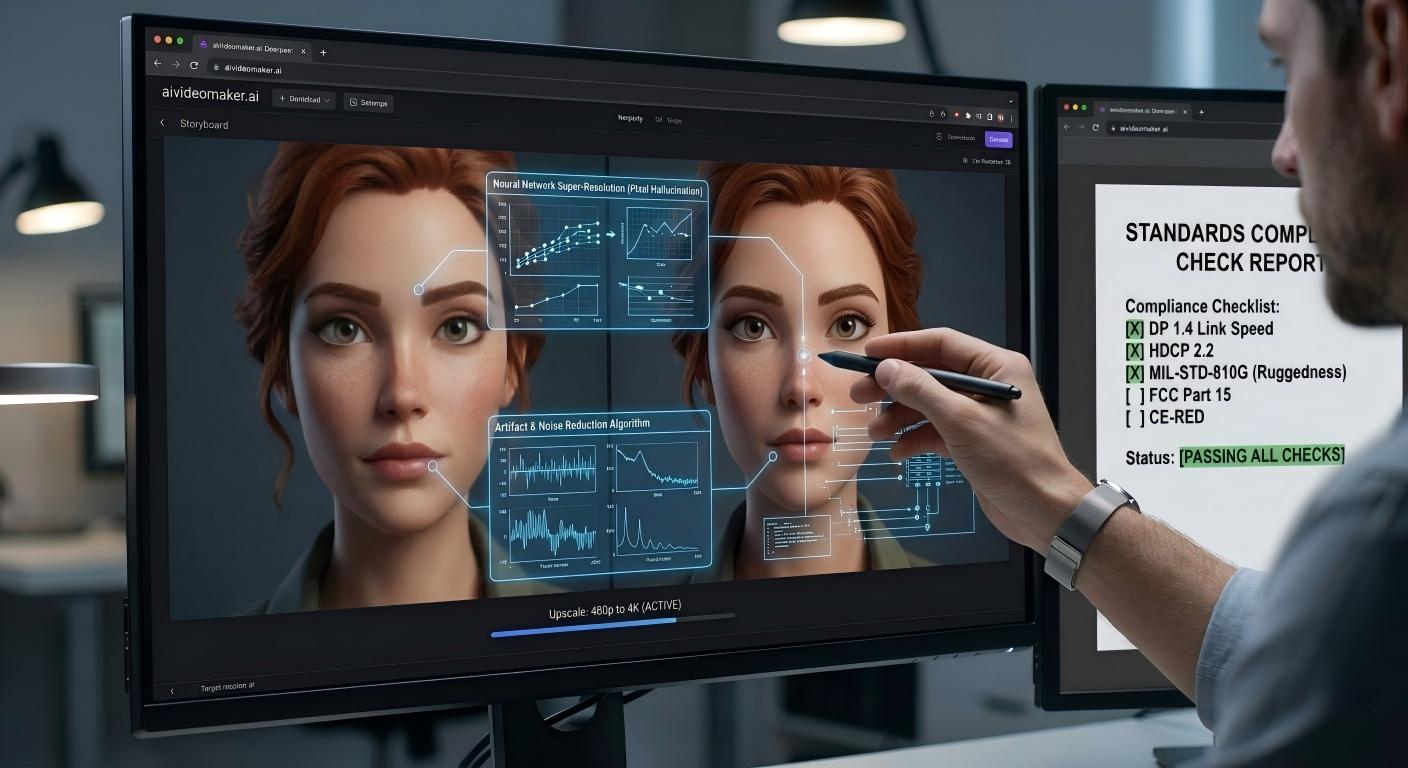
To objectively comprehend the clinical superiority of algorithmic enhancement, post-production engineers must deeply analyze the specific neural networks dictating pixel hallucination and spatial-temporal noise reduction. Legacy upscaling engines rely on archaic mathematical interpolation---specifically Bicubic or Lanczos scaling algorithms. These rudimentary functions simply calculate the average color values of adjacent pixels to fill the void when a frame is enlarged, generating severe edge blurring and massive aliasing artifacts. Conversely, a modern reduce video noise protocol powered by generative adversarial networks (GANs) does not merely stretch pixels; it actively hallucinates them based on immense datasets of high-fidelity visual training data.
When the enhancement engine processes a degraded 480p frame, the convolutional neural network (CNN) analyzes the semantic context of the pixels. If the AI detects a human eye, a brick wall, or individual strands of hair, it mathematically generates the precise, high-frequency micro-details---the pores on the skin or the texture of the mortar---that were physically absent from the original low-resolution source data. This semantic understanding ensures that edge sharpening physics are applied contextually, avoiding the global, artificial crispness associated with legacy unsharp mask filters.
Furthermore, this pixel hallucination is inextricably coupled with aggressive spatial-temporal noise reduction algorithms. Low-bitrate compression naturally introduces massive macro-blocking, banding, and chroma noise (color bleeding). The neural network calculates the structural differential between this noise and the underlying object geometry, selectively stripping the compression artifacts before executing the upscale. By enforcing strict temporal consistency across consecutive frames, the algorithm guarantees that the newly synthesized high-frequency details remain spatially locked. This mathematically prevents the hallucinatory flickering and temporal jitter that plagued early-generation scaling software, ensuring that the resulting asset maintains the exact photometric integrity of a natively recorded HD file.
Critical Market Applications & Real-World Use Cases
The strategic deployment of AI-driven super-resolution is aggressively dictated by the hyper-accelerated distribution lifecycles of modern digital marketing architectures. In the highly competitive environment of digital asset optimization, generative AI editors frequently must synthesize draft generations quickly to meet rigorous campaign deadlines. Consequently, to conserve server compute limits during the iterative ideation phase, these drafts are exported in 480p standard definition. Therefore, when the final storyboard is approved by the creative director, the editor must immediately execute an upscale protocol to meet stringent commercial broadcast standards.
Furthermore, performance marketing agencies cannot afford to re-render the original generative text prompt at native 1080p due to extreme latency constraints and variable algorithmic outputs. Consequently, they utilize the dedicated upscaling module to upscale 480p to HD instantly, mathematicalizing the final pixel data packets into pristine high-definition inventory without altering the established geometry of the draft. Therefore, this proprietary post-production pipeline completely isolates the agency's creative velocity from computational bottlenecks, allowing them to scale their visual ad accounts exponentially.
Furthermore, archival media restoration represents a massive, highly lucrative sector for this specific neural technology. Consequently, documentary filmmakers and archival institutions possess thousands of hours of degraded VHS, Hi8, or early digital camera footage that is fundamentally unusable on modern 4K displays. Therefore, these post-production professionals actively deploy neural network upscaling to execute comprehensive AI video restoration. Furthermore, the algorithm mathematically strips the analog tape noise, corrects the chroma bleed, and hallucinates the lost high-frequency details. Consequently, this unparalleled capability allows production studios to seamlessly integrate archival clips into modern timelines without jarring drops in visual fidelity. Therefore, by outsourcing this complex visual data transformation to an automated algorithmic facility, production studios can mathematically scale their throughput and secure total commercial dominance.
Comparison Matrix: Resolution Enhancement Modalities
To objectively evaluate the structural and financial viability of varying scaling methodologies, post-production engineers must critically analyze comparative performance data. The following matrix mathematically contrasts AI Video Upscaling against legacy industry alternatives across critical performance metrics:
| Enhancement Modality | Artifact Reduction & Detail Recovery | Processing Speed & Throughput | OpEx Cost & Hardware Requirements |
|---|---|---|---|
| AI Video Upscaler (Neural Net) | Supreme. Hallucinates missing high-frequency details and actively strips macro-blocking. | Fast. Cloud-based GPU allocation renders complex sequences in minutes. | Minimal. Requires only a standard SaaS subscription; zero local hardware load. |
| Standard NLE (Premiere/FCPX) | Poor. Bicubic stretching multiplies existing compression artifacts and softens edges. | Instant (Real-time playback), but visually destructive to the final asset. | High. Demands expensive software licensing and high-end local workstations. |
| Cloud Rendering Services | Variable. Depends entirely on the specific interpolation algorithms deployed by the farm. | Slow to Moderate. Subject to massive queue times during peak global usage. | Extremely High. Pay-per-minute or pay-per-gigabyte pricing destroys profit margins. |
| Hardware Scalers (Teranex) | Good. Real-time optical scaling with excellent color space conversions, but no AI hallucination. | Absolute Real-Time (Broadcast standard). Zero latency. | Astronomical. Dedicated rack-mounted hardware costs tens of thousands of dollars. |
Post-Production Best Practices & Upscaling Specs
Executing a structurally flawless resolution enhancement requires absolute adherence to rigorous input data parameters. The raw visual data packet supplied to the neural network acts as the foundational structural seed for all subsequent pixel hallucination. If the input MP4 is severely bitrate-starved to the point of total data annihilation (e.g., heavily compressed WhatsApp footage), the AI will mathematically struggle to infer the correct geometric context. Therefore, before initiating the upscaling sequence, operators should ensure the 480p draft is exported at the highest possible bitrate natively supported by the AI video maker interface.
A highly critical operational parameter is avoiding aggressive over-sharpening. When editors push the upscaling ratio beyond the model's optimal mathematical parameters (e.g., attempting a 400% upscale from 240p to 1080p), the algorithm may introduce severe 'halo effects'---bright, unnatural, high-contrast outlines around the edges of subjects. To mitigate this, professionals must properly configure the enhancement parameters, prioritizing organic texture synthesis over harsh digital edge sharpening. This guarantees that the publish-ready AI video maintains a cinematic, filmic quality rather than a brittle, over-processed, algorithmic aesthetic.
Finally, to maximize creative scalability and visual fidelity, users must systematically manage their premium subscription processing times. Because true neural super-resolution requires massive GPU compute overhead, processing a lengthy, unedited sequence can induce rendering queues. By optimizing the in-and-out points of the clip prior to ingestion---only upscaling the exact frames required for the final master timeline edit---engineers drastically reduce the server load and accelerate their turnaround time. By adhering to these strict post-production protocols, operators guarantee that their digital assets maintain absolute clinical accuracy and visual dominance on any high-density display.
Frequently Asked Questions (FAQ)
1. What is the maximum mathematical upscale ratio before the neural network introduces severe visual artifacts?
While the AI is highly robust, pushing an upscale ratio beyond 4x (400%) generally pushes the diffusion model to over-hallucinate, resulting in unnatural, 'plastic' looking textures. The optimal sweet spot for maintaining absolute cinematic fidelity is a 2x to 3x upscale---such as scaling a pristine 480p generative draft directly to 720p or 1080p HD.
2. Can the AI upscaler restore blurry motion or out-of-focus camera shots?
The neural network excels at edge sharpening and noise reduction, but it cannot mathematically recreate depth-of-field data that was never captured. If a subject is suffering from severe optical motion blur or missed camera focus, the AI will sharpen the blurred edges, making the blur look 'crisper', but it will not fully restore the lost optical geometry of the subject.
3. What is the standard processing time variance between exporting to 720p versus 1080p?
Processing latency scales exponentially with pixel density. Upscaling a 5-second 480p clip to 720p requires generating roughly 3x the pixels, taking a few minutes. Upscaling to true 1080p requires synthesizing over 6x the pixel data, which significantly increases server-side GPU allocation time. Premium users utilize dedicated concurrent processing queues to mitigate these longer 1080p render latencies.
4. Does the upscaling engine support lossless video codecs like Apple ProRes or DNxHR?
Currently, the web-based SaaS architecture is optimized for rapid ingestion and distribution, heavily favoring high-bitrate MP4 (H.264 or H.265/HEVC) data packets to ensure efficient cloud transport. Uploading massive, uncompressed ProRes 422 HQ files will typically trigger the platform's file size saturation limits and cause the ingestion protocol to time out.
5. Will the upscaler alter the frame rate (FPS) of my original draft video?
No. The primary function of the enhancement module is strictly spatial (pixel resolution and noise reduction), not temporal (frame interpolation). If your source 480p draft is generated at 24fps, the resulting 1080p upscale will mathematically retain the exact 24fps cadence, ensuring perfect synchronization when dropped back into your NLE timeline.
6. Do I need a high-end graphics card (GPU) on my computer to run this enhancement?
Absolutely not. This is a critical advantage of cloud-based visual manufacturing. All neural network processing, pixel hallucination, and heavy rendering are executed on our secure, external GPU server clusters. You can execute complex 1080p upscaling protocols using a standard, low-power laptop without triggering any local hardware bottlenecks or thermal throttling.
Conclusion
The engineering reality within modern post-production is irrefutable: attempting to dominate the digital landscape utilizing heavily compressed, low-resolution assets guarantees catastrophic audience disengagement, algorithm suppression, and brand dilution. By migrating your final export pipeline directly to our precision-engineered AI Video Upscaler facility, you permanently mathematicalize your media's cinematic quality, structural stability, and global broadcast readiness. You guarantee absolute visual dominance by eradicating compression artifacts, synthesizing high-frequency details, and unlocking rapid speed-to-market for your entire visual catalog.
Do not compromise your brand's visual authority with substandard, pixelated exports. Secure your entire post-production supply chain by upgrading your algorithmic capabilities today. Access our Pricing and Plans to instantly mathematicalize your continuous high-definition output, drastically lower your hardware overhead, and fundamentally revolutionize your studio's commercial trajectory.